 |
Raw Stone |
 |
 |
 |
 |
 |
 |
 |
 |
 |
 |
|
Raw stone from Zimbabwe: We currently have in stock different types of green opal, some with yellow markings, some with orange ones, also spotty opal, lemon opal, camouflage opal, raindrop opal, white opal with red markings, red opal, yellow jasper, brown and black serpentine, multi-coloured cobalt, purple lepidolite, bright green verdite and black springstone. Verdite and lepidolite are semi-precious stones which can also be used for jewellery making.
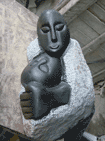
The yellow jasper and the different types of opal are suitable for people interested in soft and easy to carve stones or indeed anyone who wants to work with a colourful stone. For anyone interested in and experienced in working with hard stone, there is a choice of black springstone, brown/black serpentine, purple lepidolite and bright-green verdite. The cobalt stone, although medium soft, can be a bit tricky to carve due to its iron deposits and the fact it comes in layers (a bit like slate) but it has lots of character and comes in glorious colours.. We are open by appointment throughout the year and during workshops. If you can only come weekends, no problem. Please contact Renate on Tel: 01273 565404 or e-mail: renate@africart.tv Below are some examples of works produced by experienced artists achieved in a 2-day workshop. The stone is hard springstone.
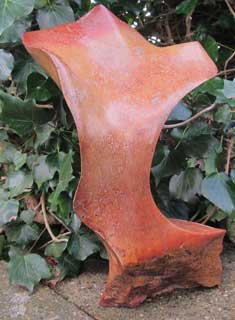
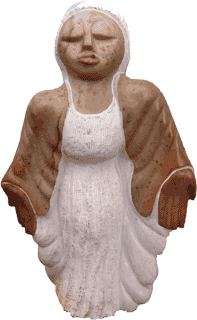
Below are samples of sculptures made from red opal and from white opal with red markings: New Stone for 2016
|
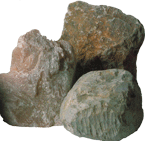

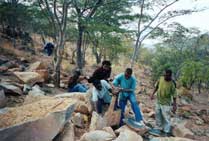
| The stone comes from the hills of the Great Dyke, a volcanic ridge that runs 310 miles through Zimbabwe's countryside - the longest linear mass of volcanic rock in the world. The rocks on these hills are interlaced with copper, chrome, platinum, gold, emeralds and other precious metals. Heat and pressure exerted on these 2.5 billion year old rocks caused unusual mineral combinations. These are reflected in the many variations of coloration, shadings and density of stone. | |
|
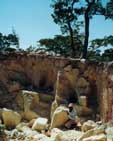
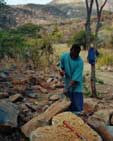
The stone is quarried
with handtools: pickaxe, prybar, punch and hammer. The harder the
stone, the more difficult the process.
|
.  |
 |
 |
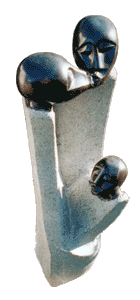
| Rated on the universally used Mohs Scale of Hardness (1 and below is talc, up to 10 is diamond), serpentine and springstone (the hard end of serpentine) ranges from 2.0 to 5.5. Opal and fruitstone is at the lower end of this range. | |
 |
|
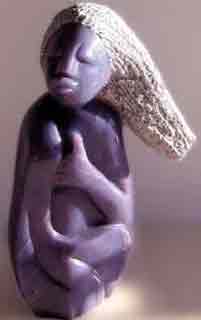
| The properties of these raw stones from Zimbabwe make them ideal for outdoor sculptures or fountains, especially those made from hard stones such as springstone, verdite or lepidolite. Sculptures made from opal stone are best brought indoors in Winter. Alternatively you can protect them with some insulating material (such as an old blanket) covered in polythene. To give the sculptures their highly polished appearance, the artists heat the stone with a blowtorch or other heat source and apply wax (Cobra in Zimbabwe, Briwax in the U.K.) until it is absorbed by the stone. This process may be repeated a couple of times but it is important to allow the stone to cool down in between. Once cool but not cold to the touch, the sculpture is buffed to a shine with a soft cloth. | |
 |
|
| A similar process may be necessary if your own sculpture becomes a little dull after a few years. If the sculpture is small enough, it is safe to put in a hot oven for between 3 and 10 minutes, depending upon size, before applying wax as before. The stone has to be hot enough to melt the wax but not so hot that it cracks. It is best to take it out of the oven every few minutes to check. Bigger sculptures can be warmed by using a blowtorch or gas or electrical paint stripping tool but care needs to be taken that the heat is evenly applied and not concentrated on any one spot.. |
email: renate@africart.tv